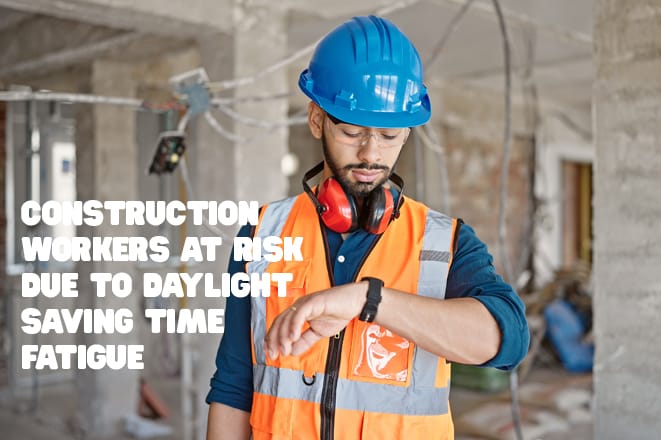
Why Changing the Clocks Could Endanger Your Business
As the clocks spring forward at the end of March, many organisations welcome longer evenings and the promise of brighter days. However, beneath this seasonal shift lies a less visible but very real risk to workplace safety and operational performance, particularly in high-risk industries such as construction.
While research into clock change work safety and the effects of Daylight Saving Time (DST) is mixed, there is growing evidence that the spring transition can have measurable safety implications.
A Subtle Shift with Serious Consequences
Some studies suggest that lighter evenings may contribute to a reduction in certain types of road accidents. However, other research highlights a more concerning trend: an increase in fatal incidents immediately following the clock change.
A widely cited study published in Current Biology found that the spring DST transition increases the risk of fatal motor vehicle accidents by approximately 6% in the week following the change. This suggests that even a one-hour shift can significantly disrupt human performance. On London’s busy streets, with construction workers often starting work early, this is a significant danger.
In parallel, workplace safety data reveals similar patterns. Research indicates that the Monday following the spring clock change sees a notable rise in workplace injuries across industries. Not only do incidents increase, but their severity also worsens, resulting in nearly 68% more lost workdays.
Why the Spring Change Matters
The underlying cause is not the clock itself, but its impact on the body’s internal timing system, our circadian rhythm.
This biological clock regulates sleep and wake cycles based on light exposure. When the clocks move forward:
- Evenings become lighter, delaying the production of melatonin (the hormone that promotes sleep)
- Mornings are darker, making it harder for the body to wake naturally
- Sleep duration and quality are reduced
The result is widespread, often unnoticed sleep deprivation.
As David Ray, professor of endocrinology and co-director of the Sir Jules Thorn Sleep and Circadian Neuroscience Institute at the University of Oxford, explains:
“Their internal clock tells them it’s 7am, but the clock on the wall says it’s 6am… if you look in large enough numbers of people, you start to see that there are problems.”
Construction: A Sector at Heightened Risk
In construction, where workers routinely operate heavy machinery, work at height, and make critical decisions under pressure, even minor fatigue can have serious consequences.
The sector already faces significant safety challenges:
- Falls from height remain the leading cause of fatalities
- In 2023/24, approximately 4,050 non-fatal injuries were reported by employers
Introducing widespread fatigue into this environment, even temporarily in the week following DST, amplifies existing risks.
A sleep-deprived worker is more likely to:
- Misjudge distances or timing
- Experience reduced reaction speed
- Overlook hazards or safety procedures
Practical Steps for Employers
While the spring clock change is unavoidable, its risks can be managed. Employers should take proactive steps to mitigate the impact on their workforce.
Recommended interventions include:
- Reinforcing safety fundamentals
Conduct “back to basics” toolbox talks focusing on key hazards and recent incidents on-site - Adjusting work scheduling
Where possible, allocate the most complex or high-risk tasks earlier in the shift when concentration levels are higher - Promoting awareness of fatigue
Encourage workers to recognise signs of tiredness in themselves and others - Reviewing supervision levels
Increase oversight during the first week following the clock change
A Timely Reminder
Although the autumn clock change is often associated with higher accident rates overall, the spring transition presents its own, distinct risks, particularly due to sleep disruption.
For businesses, especially those operating in safety-critical environments, this is a timely reminder: small changes in human performance can have large consequences.
By recognising the risks and reinforcing safety behaviour, businesses can ensure that the change to longer days does not come at the cost of worker safety. At Richardson Hill we take care of our clients and their workforces well-being, throughout the year, not just when the clocks change! For help, advice and for any further questions, contact us today.