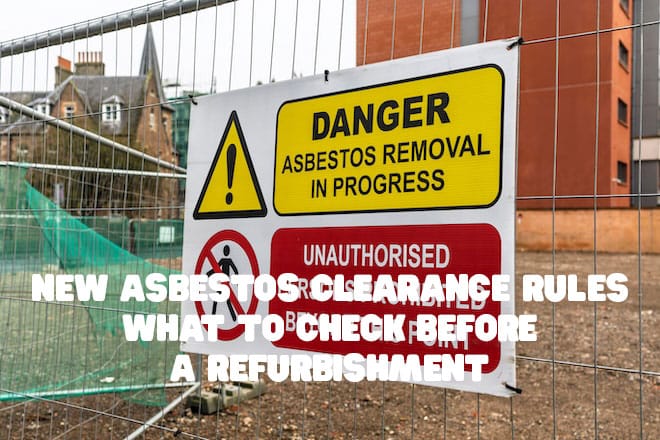
New Asbestos Clearance Rules – What to Check Before a Refurbishment
If you’re planning to refurbish an older office or commercial building, asbestos can affect the scope of the work, the programme and when people can return to the space. The Health and Safety Executive (HSE) has announced a change to strengthen the independence of asbestos clearance. For building owners, facilities managers and project teams, it’s a timely reason to check who will check and manage the new asbestos clearance rules and arrange clearance and how this will fit into the refurbishment programme.
What Is Changing?
On 3 November 2026, HSE published its response to a consultation on the Control of Asbestos Regulations 2012. The amendment to regulation 20 addresses the potential conflict of interest that can arise when the licensed asbestos removal contractor appoints the analyst who assesses whether the area can be handed back. HSE already strongly recommends that the building owner or client in control of the premises appoints the analyst independently. HSE guidance on managing asbestos in buildings.
HSE says the amendment is due to come into force on 24 November 2026, subject to parliamentary procedure, with enforcement from November 2027. HSE also plans to update its guidance and continues to strongly recommend using accredited organisations for asbestos surveys. Read the HSE announcement.
Does Your Asbestos Survey Cover the Work You’re Planning?
Start with the building’s asbestos register and existing survey information. Compare the areas surveyed with the parts of the building the refurbishment will disturb. For example, a facilities manager planning an office refit might have a management survey for normal occupation and routine maintenance. The refit could involve removing partitions, opening ceiling voids or taking up flooring in areas the survey did not inspect. A refurbishment and demolition survey needs to cover the parts of the building fabric that the planned work will disturb. HSE guidance on asbestos surveys before refurbishment.
In an occupied building, the survey itself can affect staff and tenants. Agree when the surveyor can gain access and which spaces will need to be vacated. Share the findings with the design and construction teams so they can take them into account in the design, construction risk assessments and programme.
If you’re unsure whether your existing asbestos information covers the proposed refurbishment, you can appoint Richardson-Hill as your CDM Client Adviser. We can review the information you hold against the planned works, identify gaps that may need a specialist survey or further investigation, and advise on what to share with designers and contractors before work starts. Find out more about our CDM client advisory services.
Who Will Arrange Clearance, and When Can People Return?
Where four-stage clearance is required, agree who will appoint the accredited clearance organisation, when the analyst will need access and who will check the Certificate for Reoccupation before the area is handed back.
The process includes a preliminary check of the site and work area, a thorough visual inspection, air monitoring and a final assessment after the enclosure has been dismantled. Allow time for these steps before booking follow-on trades or confirming when staff can return. If further cleaning or a repeat inspection is needed, it can affect the next phase of work. HSE’s asbestos analysts’ guide.
How Can a CDM Principal Designer Help?
If your refurbishment involves, or is likely to involve, more than one contractor, the client must appoint a Principal Designer in writing under CDM 2015. An early appointment gives the design team time to act on the survey findings while the layout, specifications and services routes can still be changed. HSE guidance on the Principal Designer role.
You can appoint Richardson-Hill as your CDM Principal Designer to coordinate health and safety during the pre-construction phase. For example, if a survey identifies asbestos along a proposed services route, we can help the design team consider whether the route can be changed to avoid disturbing it. We can also help ensure that information about any remaining risks reaches the principal contractor so it can be taken into account when planning the work. Read our CDM Principal Designer FAQs.
What Should the Project Team Agree Before Work Starts?
- Check the survey against the scope. Confirm that it covers the rooms, voids and materials the work will disturb.
- Share the findings early. Give designers and contractors the relevant asbestos information in time to act on it.
- Agree who arranges clearance. Where four-stage clearance is required, identify who will appoint the independent analyst and who will receive and check the certificate.
- Plan the hand back. Allow time for clearance before follow-on trades or occupants return to the affected area.
- Check again if the scope changes. An extra opening or a revised services route can take the work into an area outside the original survey scope.
Talk to Richardson-Hill About the Asbestos Clearance Rules Before Your Refurbishment Starts
If you’re planning an office or commercial refurbishment in London or the South East, speak to us while there’s still time to act on survey findings and adjust the design or programme. Whether you need advice on the information you already hold or want to appoint a CDM Principal Designer, tell us what you’re planning, what asbestos information is available and when you expect work to start. We can discuss the scope of our appointment and how we would work with your project team and specialist asbestos providers.
Contact Richardson-Hill to discuss your refurbishment or call 020 8524 8396.